Backlinks Analysis
The Backlinks module provides a full view of the client's external backlink profile using DataForSEO data. It covers referring domains, dofollow/nofollow ratios, keyword ranking distribution by position, and estimated organic traffic value.
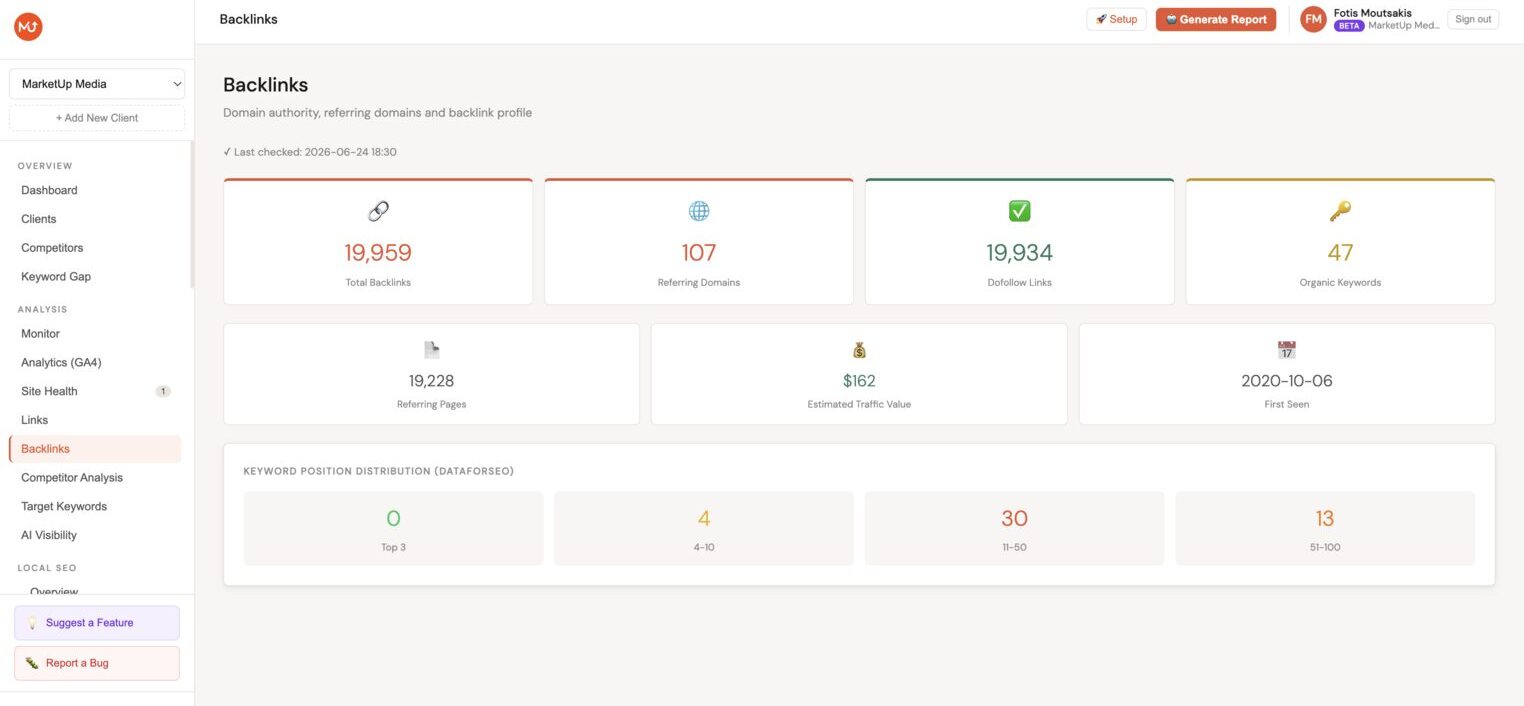
Summary metrics
Six headline metrics at the top of the page:
| Metric | Description |
|---|---|
| Total backlinks | All external links pointing to the client's domain |
| Referring domains | Number of unique root domains linking to the site |
| Dofollow links | Links passing SEO authority (not tagged nofollow) |
| Organic keywords | Keywords the domain ranks for in the top 100 |
| Referring pages | Number of individual pages linking in (across all referring domains) |
| Est. traffic value | Estimated monthly value of organic traffic in USD (based on CPC × traffic volume) |
| First seen date | When the domain's backlink profile was first indexed |
Keyword position distribution
A bar chart showing the distribution of the client's ranking keywords across position buckets:
| Position bucket | Label |
|---|---|
| 1–3 | Top 3 |
| 4–10 | First page |
| 11–50 | Second and third page |
| 51–100 | Low rankings |
This chart is a quick visual check of the keyword portfolio's health, a strong backlink profile typically correlates with a higher proportion of Top 3 and First Page keywords.
Referring domains
The referring domains section lists the most authoritative external sites linking to the client. For each domain:
- Domain and domain authority score
- Backlinks from this domain, number of individual pages linking in
- Dofollow / nofollow, whether the links pass authority
- First seen, when the first link from this domain was detected
A site with 50 referring domains from high-authority, relevant websites is far stronger than one with 5,000 links from low-quality sources.
Dofollow vs nofollow
The dofollow/nofollow breakdown shows what proportion of the backlink profile is passing authority. Most healthy link profiles have 70–90% dofollow links. A very high nofollow proportion may indicate that most links come from directories, forum posts, or social profiles rather than editorial coverage.
Monthly organic traffic chart
A 12-month chart of estimated organic traffic, the same view available in competitor analysis. Useful for tracking whether backlink acquisition efforts correlate with traffic growth over time.
Interpreting the data
Referring domains matter more than total backlinks
A single domain can link to you from 100 pages, but that still counts as 1 referring domain. The referring domain count is a better measure of link profile breadth than total backlink count.
Dofollow ratio matters
A high proportion of nofollow links (above 40%) is worth investigating. It may mean the link profile relies too heavily on directory submissions or social platforms rather than earned editorial links.
Traffic value as a proxy
Estimated traffic value (organic keywords × estimated traffic × average CPC) is a rough proxy for the commercial value of the site's organic visibility. Track it month-over-month to confirm that SEO investment is translating into measurable visibility.
Next steps
- Competitor Analysis, compare the client's backlink profile with competitors
- Internal Links Analysis, complement backlink work with strong internal linking
- AI SEO Reports, backlink data is included in monthly reports