Internal Links Analysis
The Internal Links module analyses the internal link structure of the client's WordPress site and surfaces pages that are poorly linked, orphaned, or at risk of being under-valued by search engines due to low internal link equity.
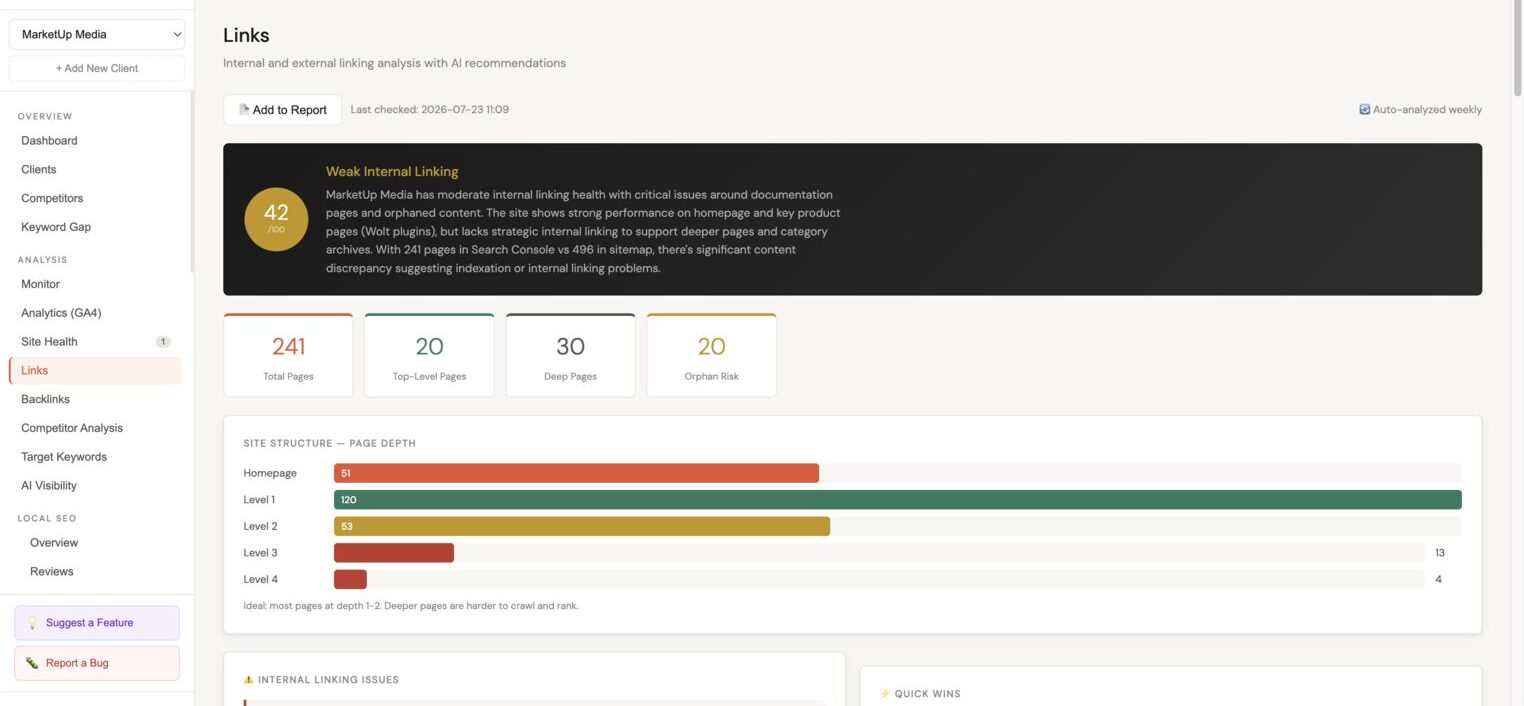
Overview metrics
Four summary metrics at the top of the page:
| Metric | What it means |
|---|---|
| Total pages | Number of pages crawled and analysed |
| Orphaned pages | Pages with zero internal links pointing to them |
| Deep pages | Pages more than 3 clicks from the homepage |
| Link equity score | Overall internal linking health (0–100) |
Page depth distribution
A bar chart showing how your pages are distributed across depth levels:
| Level | Description |
|---|---|
| Homepage | The homepage (depth 0) |
| Level 1 | Pages linked directly from the homepage (1 click away) |
| Level 2 | Pages reached in 2 clicks |
| Level 3 | Pages reached in 3 clicks |
| Level 4+ | Pages requiring 4+ clicks to reach |
Pages at level 4+ are typically under-crawled and under-valued. The goal is to keep important pages within 3 clicks of the homepage.
Internal linking issues
Issues are categorised by type:
Orphaned pages
Pages that exist on the site but have no internal links pointing to them. Search engines may not find or index these pages consistently. Each orphaned page is listed with:
- The URL
- Whether it's in the sitemap (a mismatch of "sitemap yes, internal links zero" is a high-priority fix)
- Suggested pages to link from
Deep pages
Pages requiring 4+ clicks to reach from the homepage. Prioritised by their GSC traffic, high-traffic pages that are difficult to reach via internal linking are wasting ranking potential.
Link equity issues
Pages receiving significantly fewer internal links than their performance warrants, for example, a page driving 30% of organic traffic that only has 2 internal links pointing to it.
Quick wins list
A ranked list of the fastest-to-fix internal linking improvements, sorted by estimated SEO impact. For each quick win:
- The page that needs more links
- The recommended number of additional internal links
- Which pages to link from (specific URL recommendations)
Specific link recommendations
For each recommended internal link, Minorank provides:
| Field | Example |
|---|---|
| From page | /services/car-rental/ |
| To page | /services/car-rental/crete/ |
| Anchor text | "car rental in Crete" |
| Why | "This page has high authority but no links to its location-specific child page" |
These are ready to implement, no guesswork needed.
Pages at risk of orphaning
A list of pages that currently have only 1–2 internal links. If any of those linking pages are deleted or reorganised, these pages will become orphaned. Pre-emptively adding more links to these pages protects against future orphaning.
Suggested pillar pages
Based on the site's content structure, Minorank identifies topics that would benefit from a dedicated pillar page, a comprehensive hub page that links to related child pages (cluster content). Creating or designating pillar pages strengthens the internal link structure and topic authority simultaneously.
External link building strategy
Beyond internal links, the analysis also surfaces pages that are strong candidates for external link building, based on their organic traffic potential, current internal link strength, and content quality signals. These are pages that would benefit most from acquiring backlinks.
Next steps
- Backlinks Analysis, check external backlink profile alongside internal link health
- Site Health, find other technical SEO issues
- Tasks, convert link recommendations into tracked tasks